Alberta iela and Elizabetes iela: Art Nouveau walking route
What is the best walking route for Art Nouveau in Riga?
Start on Alberta iela at the junction with Elizabetes iela. Walk all of Alberta iela (about 400 metres), paying attention to nos. 2, 4, 6, 8, 11, and 13. Return via Strēlnieku iela and Elizabetes iela. Total walk: 90 minutes at a slow pace, free of charge.
Getting to the starting point
The walk begins at the junction of Alberta iela and Elizabetes iela, in the Quiet Center district (Klusais centrs) of central Riga. From Riga Old Town, this is a 15–18-minute walk north through the canal park: cross the canal at the Bastejkalns footbridge, continue up Kr. Barona iela, and turn left on Elizabetes iela. Alberta iela is one block further north.
Alternatively, take Bolt from Old Town (4–5 minutes, €4–5) or tram 6 from the Freedom Monument stop to the Kr. Barona / Elizabetes stop. If you are walking from the Central Station area, head north on Brīvības bulvāris and turn right on Elizabetes iela — about 20 minutes.
Alberta iela: building by building
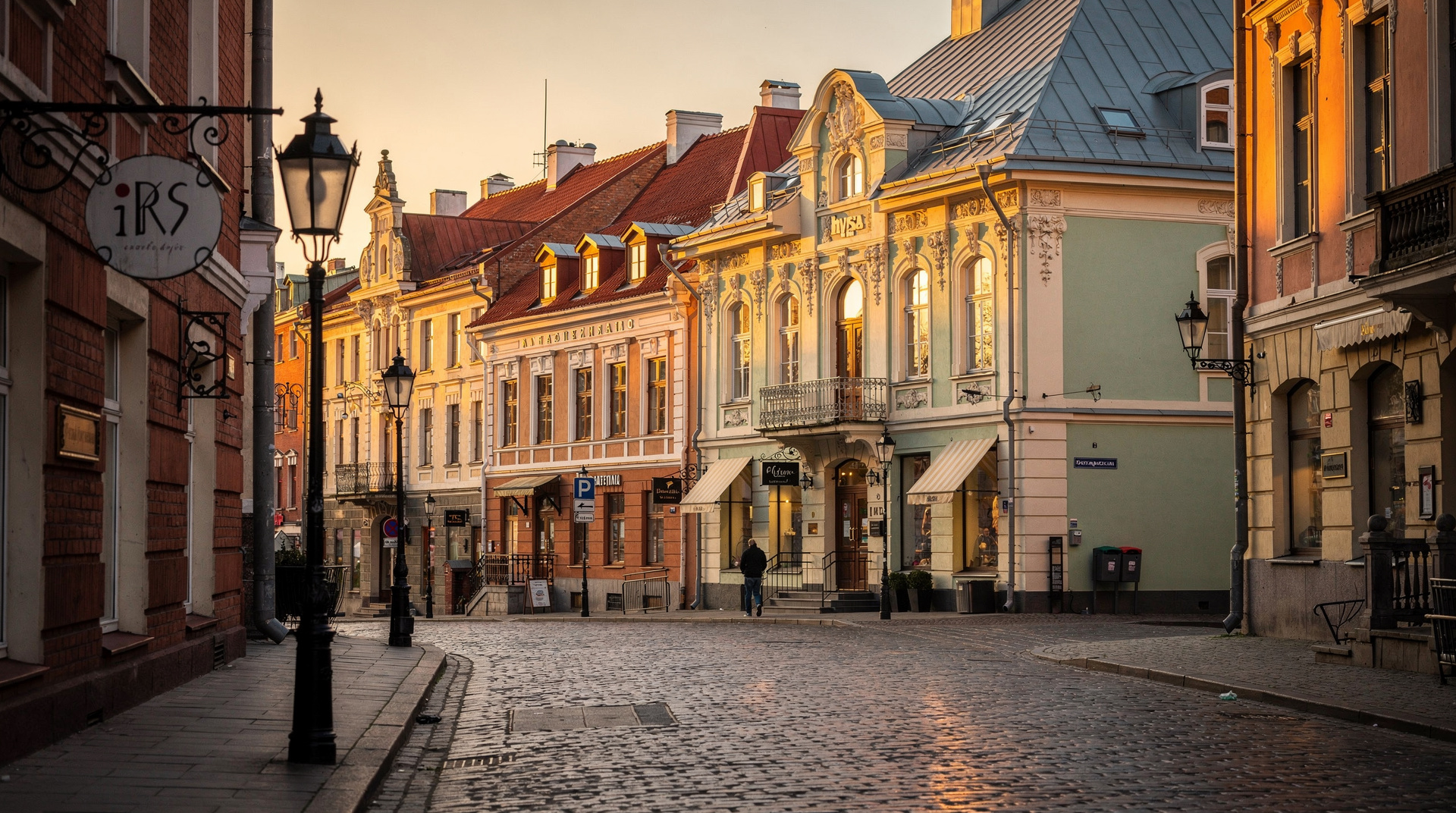
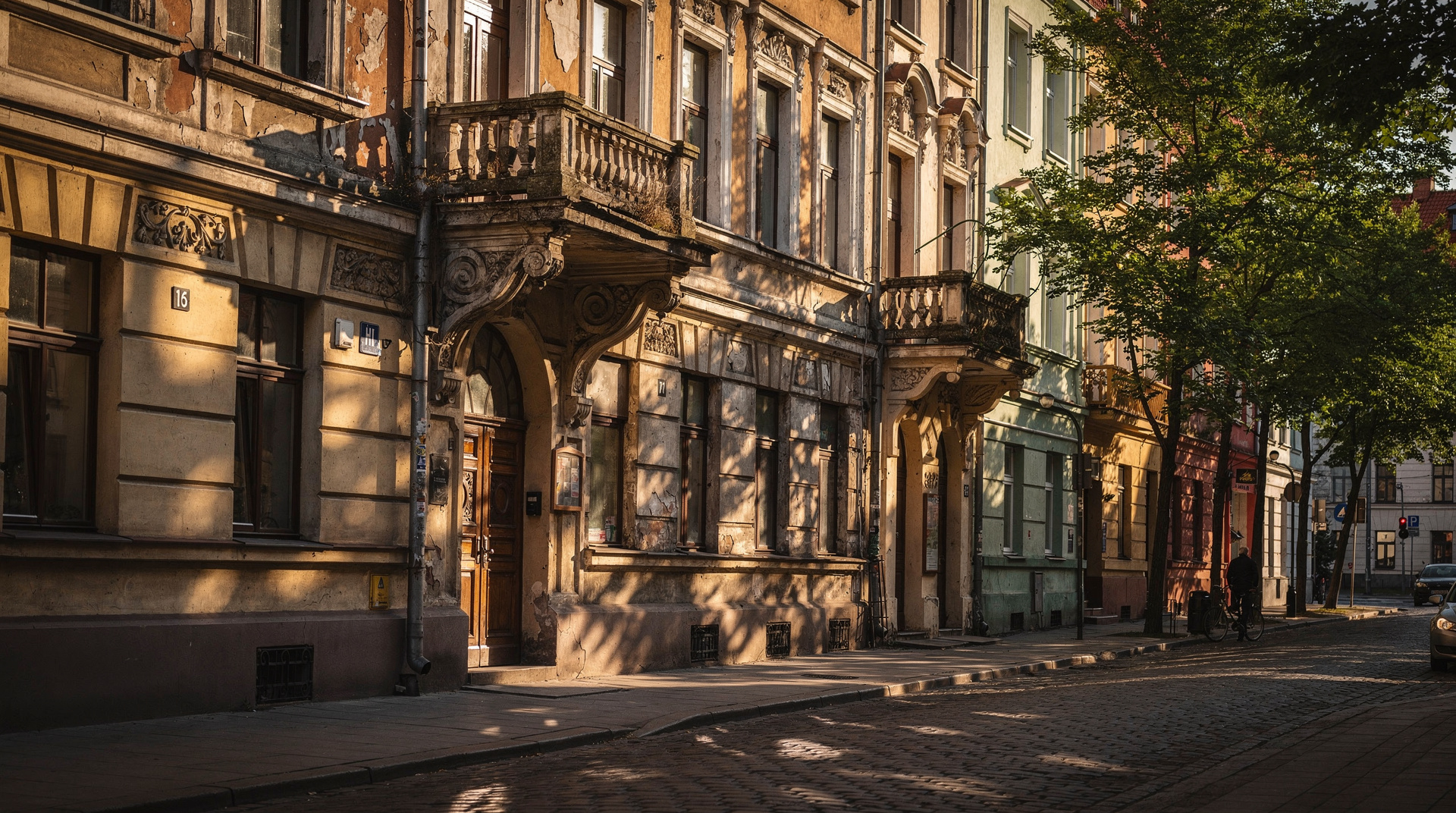
Alberta iela runs about 400 metres from its junction with Elizabetes iela northward to Kronvalda bulvāris. The even-numbered buildings are on the east side; odd numbers on the west. Walk the full length slowly — do not rush this street.
Alberta iela 2 (1906, Mikhail Eisenstein)
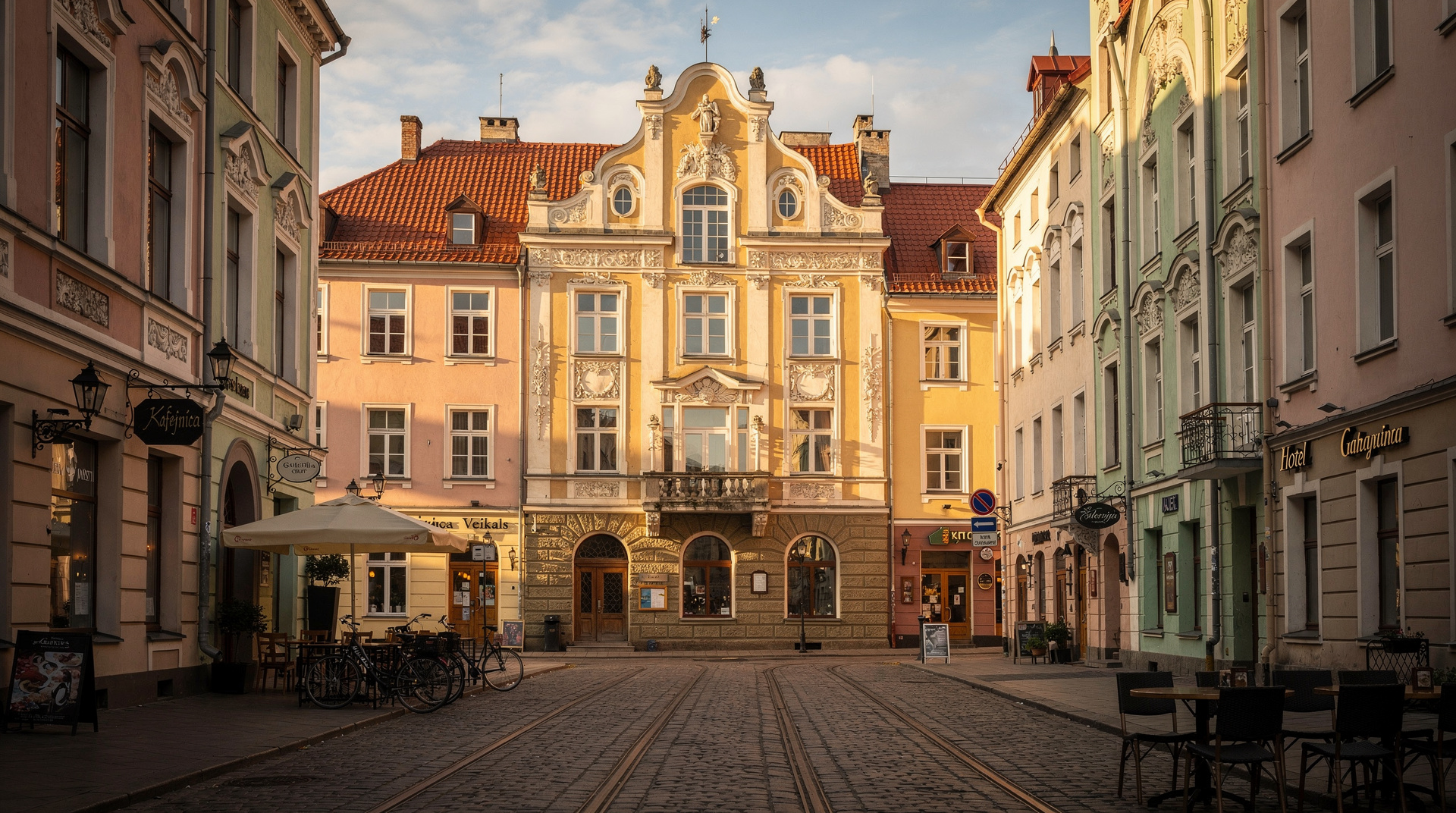
The most frequently photographed facade in the entire Art Nouveau district, and possibly the most extravagant in all of Riga. Three colossal female mask keystones sit above the arched entrance portal, their mouths open in what might be interpreted as ecstasy or anguish depending on your temperament. Flanking the portal are four atlante figures — male caryatids bearing the weight of the upper storeys — and the surface between the second and third floors is covered in a continuous frieze of stylised plant forms. The roofline is broken by decorative gables with circular windows framed by more female figures. The ochre-and-white colour scheme is close to the original 1906 palette. Stand on the opposite pavement to take in the full composition — it does not reward being too close.
Alberta iela 4 (1904, Eisenstein)
A slightly more restrained composition than number 2, which makes it easier to study individual motifs. The centrepiece here is a pair of lion-head keystones above the entrance arch — less dramatic than the female masks next door but more precisely detailed. The balconies on the second floor have particularly fine ironwork. Note the griffins at the roofline and the way Eisenstein uses the bay windows to create a vertical rhythm that draws the eye upward through the facade.
Alberta iela 6 (1904, Eisenstein)
The palest building on the street — pale grey-blue — which gives the ornamental details a more sculptural, three-dimensional quality than the warmer-toned facades. The central entrance bay is dominated by a sphinx above the third-floor window: an unusual motif in Riga and one that suggests Eisenstein was drawing on Egyptian Revival sources alongside the organic Art Nouveau vocabulary. The building is currently in office use; the ground floor commercial frontage has been sensitively retained.
Alberta iela 8 — the Art Nouveau Museum
The building at number 8 was designed in 1903 by the court architect Friedrich Scheffel and served as a private apartment building until it was converted into the Art Nouveau Museum. The facade is relatively understated compared to the Eisenstein buildings — the emphasis is on elegant proportions and fine decorative ironwork rather than on dramatic sculptural set-pieces. Inside, the museum has preserved the original apartment of a middle-class Riga family from the early 1900s: tile stoves, parquet flooring, dining furniture, and wallpaper in the characteristic Jugendstil palette of olive greens and warm yellows. Entry is €6 and the visit takes 45–60 minutes. This is the only interior on Alberta iela that you can legitimately enter, and it is worth it. Open Tuesday to Sunday 10:00–18:00.
Alberta iela 9 (1908, Konstantīns Pēkšēns)
Crossing to the odd-numbered west side, number 9 is the first major example of National Romanticism on the route. Pēkšēns and his contemporaries in this movement drew on Latvian folk traditions rather than on Viennese or Belgian sources. The facade uses rough-hewn granite for the base (very different from the smooth stucco of the Eisenstein buildings), ceramic tile friezes with stylised Latvian folk motifs, and a simplified ornamental vocabulary that feels grounded and solid rather than theatrical. The building reads as a deliberate counterstatement to the Eisenstein facades across the street.
Alberta iela 11 (1908, Pēkšēns)
The larger National Romanticism building a few doors down from number 9. The street-level base is particularly fine — rough granite ashlar giving way to smooth brick with ceramic tile insets. The entrance portal uses simplified geometric ornament rather than figurative sculpture, and the overall composition has a gravity that the eclectic buildings lack. Pēkšēns, who was Latvian rather than the Baltic German Eisenstein, was making a cultural as well as an architectural argument.
Alberta iela 13 (1904, Eisenstein)
The theatrical climax of the street. Eisenstein here deployed his most elaborate figural programme: two massive caryatid figures — draped female forms — flank the entrance portal, their faces turned downward in a posture somewhere between exhaustion and submission. Above the portal, a screaming Medusa head looks directly at the viewer. The upper floors cascade with female masks, floral reliefs, and wreath motifs, and the roofline is interrupted by decorative gables and circular dormer windows. The building is in private residential use; the entrance vestibule (sometimes accessible through the street door) has retained its original tile floor and ironwork staircase balusters.
Join a guided Art Nouveau walking tour to understand the symbolism (€22, 2 hours)Strēlnieku iela: the connector
At the top of Alberta iela, turn left onto Kronvalda bulvāris and then immediately left again onto Strēlnieku iela, which runs parallel to Alberta iela on its west side. This street is less famous but contains some of the best Perpendicular Art Nouveau in the city.
Strēlnieku iela 4a (1905, Pēkšēns and Laube) — a tall perpendicular building with a distinctive green ceramic tile frieze at the third floor and an almost skeletal treatment of the bay windows. The facade grid of verticals and horizontals anticipates early modernism while still incorporating decorative details in the Jugendstil vocabulary.
Strēlnieku iela 2 — the corner building at Elizabetes iela is a well-preserved example of the commercial Art Nouveau that bordered the residential Quiet Center. The ground floor has been adapted but the upper storeys retain the original decoration.
Elizabetes iela: heading south
Turn right onto Elizabetes iela and walk south, back toward your starting point. This is the busier of the two parallel streets — it carries tram lines and through traffic — but the building quality is consistently high.
Elizabetes iela 10b (1903, Eisenstein) — a corner building that wraps around the intersection with Antonijas iela. Five decorated bay windows climb the facade, each topped with Eisenstein’s characteristic screaming heads at the cornice. The corner itself is resolved with a curved section and a conical turret, a compositional device that Eisenstein used to particular effect here.
Elizabetes iela 23 — one of the best-preserved entrance vestibules in the district. The street door is sometimes unlocked during business hours; if so, step inside briefly to see the original tile floor, the cast-iron staircase, and the decorative plasterwork on the entrance arch. Be respectful of residents.
Elizabetes iela 33 (1901, Laube) — a major National Romanticism building, earlier than the Pēkšēns examples on Alberta iela. The rough-hewn stone base is particularly imposing, and the upper ceramic tile friezes use a Latvian folk motif vocabulary with considerable restraint and confidence. The building is considered one of the founding examples of the National Romanticism movement in Latvian architecture.
Elizabetes iela 41b — the Latvian Museum of Decorative Arts and Design occupies part of this building. The permanent collection includes applied arts from the Art Nouveau period alongside 20th-century Latvian design. Entry is modest (around €3) and the museum is rarely crowded.
Pulkveža Brieža iela: the side street worth a detour
Before finishing the walk, detour one block west along Pulkveža Brieža iela (formerly Nikolaja iela), which connects Elizabetes iela with Alberta iela. Buildings at numbers 8 and 11 are particularly instructive for seeing the transition from eclectic to perpendicular styles: number 8 is a full-blown eclectic building with elaborate figural ornament; number 11 is a contemporary building by a different architect that uses the same compositional vocabulary with much more restrained decoration.
Explore the full Art Nouveau district with an expert guide (€18, 2 hours)Honest tips for this route
Bring a notebook or use your phone’s note function. The facades on this route contain so much detail that photography alone will not retain the experience. Write down the addresses of buildings you want to research further — the symbolic programmes of several Eisenstein buildings have been extensively documented in Latvian architectural literature, some of it available in English.
Don’t try to do Old Town and Alberta iela on the same morning. The combination is popular and theoretically possible — it is only a 15-minute walk between them — but in practice the Art Nouveau route deserves at least 90 minutes of undivided attention. Split the day: Old Town before noon, lunch near the canal park, Art Nouveau in the afternoon.
The museum interior requires energy. If you are walking this route after a morning of Old Town sightseeing, the Art Nouveau Museum interior can feel like one thing too many. Either do it first or save it for a second, shorter visit. The exterior route is satisfying on its own.
Rain is not a deterrent. The facades are in stone and stucco and read well in grey light. Wet pavements reflecting the facades can make for excellent photographs. This is one of the few Riga experiences that is not significantly worse in bad weather.
Continuing your Art Nouveau exploration
This route covers the core of the Alberta–Elizabetes concentration. For a broader understanding of Art Nouveau across Riga’s central districts, the walking tour options on GetYourGuide take in streets beyond this immediate area — including commercial buildings on Brīvības iela and the mix of styles on Kr. Valdemāra iela.
For the background on Mikhail Eisenstein — the dominant architect of the eclectic period and the creator of the most dramatic facades on Alberta iela — see our dedicated guide to Mikhail Eisenstein buildings. For the interior experience and context, see our guide to visiting the Art Nouveau Museum. For a comparison of guided tour options at different price points, see best Art Nouveau walking tours compared.
How long does the Alberta and Elizabetes walking route take?
Allow 90 minutes for the full exterior route, or 2.5 hours if you include the Art Nouveau Museum interior at Alberta iela 12 (€6 entry). The walk is about 1.5 km in total including back-streets.
Is the walking route accessible?
Largely yes. Pavements are paved and mostly even. Alberta iela is a quiet residential street with light traffic. Elizabetes iela is busier but has good pavements throughout. Cobblestones are minimal in this neighbourhood compared to Old Town.
What should I look for on the facades?
The key motifs in Riga’s eclectic Art Nouveau are: female masks with open mouths (keystones above doorways), caryatid figures flanking portals, griffins and sphinxes at rooflines, and intricate floral reliefs along the upper storeys. Each building has its own symbolic programme — a good guidebook or tour explains the specific references.
Can I enter any of the buildings?
Most buildings on Alberta iela are private residential or office properties and the interiors are not open to the public. The exception is Alberta iela 12, the Art Nouveau Museum, which is open Tuesday to Sunday 10:00–18:00. Some buildings have preserved vestibules accessible through unlocked street doors — these are technically common areas, but it is courteous to enter quietly and leave quickly.
Are there cafes on or near the route?
Elizabetes iela has several good options including Rocket Bean Roastery at Miera iela (a 5-minute detour) and several cafes on Kr. Barona iela. Alberta iela itself is a quiet residential street with no cafes. Budget a coffee break on Elizabetes iela after finishing the Alberta walk.
The neighbourhood beyond the facades: what else is on these streets
The architectural walk is the primary purpose of visiting Alberta iela and Elizabetes iela, but the neighbourhood has practical amenities and additional points of interest worth knowing about.
Aspazijas bulvāris and the canal park. The route from Old Town to the Art Nouveau district passes through the canal park — a green belt separating the medieval old city from the New Town. The park is pleasant in all seasons, with the Opera House on the north bank of the canal. This is not an architectural destination but is an enjoyable transition between Old Town and the New Town, and helps orient visitors to Riga’s spatial structure.
The National Theatre (Nacionālais teātris) is on Kr. Valdemāra iela at the northern end of the park, a short walk from Elizabetes iela. The building (1902) is a late historicist structure with some Jugendstil elements in the interior — architecturally interesting and practically relevant if you want to attend a Latvian theatre performance. Check the programme for performances with surtitles.
The Quiet Centre (Klusais centrs). The Art Nouveau district sits within what Riga residents call the Klusais centrs — the Quiet Centre — a residential neighbourhood of wide tree-lined streets and apartment buildings that is noticeably calmer than Old Town or the commercial parts of the New Town. The contrast between the loud ornamental facades and the quiet neighbourhood is itself interesting. After completing the Alberta–Elizabetes route, walking west along Elizabetes iela to the Kr. Barona iela intersection gives a sense of the broader Quiet Centre character.
Rocket Bean Roastery (Kr. Barona iela 31). The leading specialty coffee roaster in Riga is a 5-minute walk from Alberta iela. The roastery café at Barona 31 is in a converted warehouse space with an open roasting area visible from the café. A flat white after the Art Nouveau walk, watching the roaster work and knowing the beans they are using came from Ethiopia or Guatemala, is one of the more quietly satisfying experiences in this part of Riga. See our coffee culture guide for the full context.
Practical tips for getting the most from the walk
Download the map before you go. The street numbering on Alberta iela (even numbers on the west side, odd on the east) is straightforward, but having a downloaded map prevents missed buildings when you are looking up rather than at your phone screen.
Wear comfortable shoes. The pavements on Alberta iela are mostly well-maintained but there are sections of uneven paving, particularly near the driveways. Elizabetes iela has better pavements generally.
Plan around the museum opening hours. The Art Nouveau Museum at Alberta iela 12 is closed on Mondays. If a museum visit is part of your plan, verify the days open before scheduling your walk.
Consider the walk as a loop. The most natural route walks the east side of Alberta iela (odd numbers) from the Elizabetes iela end to Alberta iela at the park, crosses, and returns down the west side (even numbers), ending at the museum. This means you approach each side’s best buildings from below, looking up as you walk — the way the facades were designed to be seen.
Stop for the details at close range. The facades are designed at two scales: the overall composition (readable from across the street) and the close-detail ornamental programme (readable at arm’s length from the facade). Most visitors only see the composition. The close details — the individual face expressions, the texture of the stucco, the individual carved elements — reward specific attention.
The walk in different seasons
Spring. The lime trees that line Alberta iela are not yet in full leaf, which means the facades are fully visible without obstruction. The light in late April and May is excellent for photography. The pavement is dry after the winter.
Summer. The trees are in full leaf, which softens the visual presentation of the facades and creates pleasant shade. Summer crowds on Alberta iela are light compared to Old Town — this is not a mass tourism destination in the way that Town Hall Square is. Morning walks (before 09:00) find the street entirely quiet.
Autumn. The lime tree leaves turn yellow and gold in October, creating a colour combination with the cream and yellow stucco facades that is genuinely photogenic. October light in Riga is lower and warmer than summer light and produces good facade photography conditions.
Winter. Alberta iela in snow is atmospheric — the ornamental facades against a white background, few visitors, short days requiring morning or artificial light photography. The museum is heated and provides a warm interior contrast to the cold exterior walk. Worth the visit in winter, but dress appropriately.
What to read before or after the walk
On site: The information panels at the Art Nouveau Museum (Alberta iela 12) provide the most accessible English-language overview. The museum bookshop stocks academic and popular publications on Riga Art Nouveau in English, German, and Latvian.
Before your visit: The Riga Tourism Development Bureau produces a free downloadable map of Art Nouveau buildings (available from rigalatvia.eu). The map covers buildings beyond the Alberta–Elizabetes concentration and is useful for visitors who want to explore the broader district.
Guided tour as extension: If the self-guided walk leaves you wanting more interpretive depth, the Art Nouveau history walking tour (€22, 2 hours) picks up where independent exploration reaches its limits — specifically in explaining the symbolic ornament and its architectural context.
Frequently asked questions
How long does the Alberta and Elizabetes walking route take?
Allow 90 minutes for the full exterior route, or 2.5 hours if you include the Art Nouveau Museum interior at Alberta iela 12 (€6 entry). The walk is about 1.5 km in total including back-streets.Is the walking route accessible?
Largely yes. Pavements are paved and mostly even. Alberta iela is a quiet residential street with light traffic. Elizabetes iela is busier but has good pavements throughout. Cobblestones are minimal in this neighbourhood compared to Old Town.What should I look for on the facades?
The key motifs in Riga's eclectic Art Nouveau are: female masks with open mouths (keystones above doorways), caryatid figures flanking portals, griffins and sphinxes at rooflines, and intricate floral reliefs along the upper storeys. Each building has its own symbolic programme — a good guidebook or tour explains the specific references.Can I enter any of the buildings?
Most buildings on Alberta iela are private residential or office properties and the interiors are not open to the public. The exception is Alberta iela 12, the Art Nouveau Museum, which is open Tuesday to Sunday 10:00–18:00. Some buildings have preserved vestibules accessible through unlocked street doors — these are technically common areas, but it is courteous to enter quietly and leave quickly.Are there cafes on or near the route?
Elizabetes iela has several good options including Rocket Bean Roastery at Miera iela (a 5-minute detour) and several cafes on Kr. Barona iela. Alberta iela itself is a quiet residential street with no cafes. Budget a coffee break on Elizabetes iela after finishing the Alberta walk.
Top experiences
Bookable activities with verified prices and instant confirmation on GetYourGuide.