Riga Central Market: the complete visiting guide
Riga: Central Market traditional food tour in a small group
Duration: 2 hours
- Tastings included
- Small group
What is Riga Central Market and when is the best time to visit?
Riga Central Market (Centrāltirgus) is one of the largest covered markets in Europe, operating in five former Zeppelin hangars from the 1920s. UNESCO listed it alongside Riga's historic centre. Best time to visit is Tuesday to Friday morning (08:00–11:00). Avoid Monday (quiet, some vendors closed) and weekend afternoons (crowded). Guided food tours run daily and cost €40–48.
The Zeppelin hangars: architecture before food
Before talking about what to eat at the Central Market, it is worth spending a moment on what you are standing inside. The five covered pavilions of the Riga Central Market are former Zeppelin hangars — built by Germany between 1913 and 1917 to service the rigid airships that were used for both military reconnaissance and bombing runs during World War I. After the war, Latvia acquired the hangars as part of the restitution terms and transported them in sections from Vaiņode (in Latvia’s Kurzeme region, where they had been temporarily stored) to Riga, where they were reconstructed on the banks of the Daugava near the Central Station between 1924 and 1930.
The engineering behind this transformation was extraordinary. The hangars were designed to accommodate aircraft with wingspans exceeding 100 metres; the largest market hall (the meat pavilion) still has one of the largest clear-span interior spaces in Latvia. When they were repurposed as market halls, the hangars were fitted with windows, ventilation systems, and the tiled interior surfaces that define their current appearance. UNESCO recognised the market’s exceptional architectural and cultural value when it listed the Central Market alongside Riga’s historic centre and Art Nouveau quarter on the World Heritage register in 1997.
Looking up from inside the meat or dairy pavilion at the vaulted steel ribs of the original hangar structure — now filtered through the smells of smoked fish and fresh dill — is one of the genuinely memorable moments of a Riga visit.
The five pavilions and what they contain
The meat pavilion (Gaļas paviljons) — the largest of the five halls. Latvian beef, pork, poultry, and game, mostly from local farms. The vendors here are generally straightforward producers or local distributors; this is not a gourmet market in the Boqueria sense. The smoked meats section at the far end of the hall is particularly good: cold-smoked pork, smoked chicken, and the excellent Latvian smoked ribs (karbonāde) that are one of the market’s best casual purchases.
The fish pavilion (Zivju paviljons) — second-largest, and arguably the most interesting for visitors unfamiliar with Baltic food culture. Smoked eel from Latvian rivers, smoked Baltic herring (sprotes), smoked bream, fresh pike-perch, and the various preparations of sprat that form a significant part of traditional Latvian diet. The fish at the Central Market is primarily from the Baltic and from Latvian rivers and lakes — not deep-sea fish, but the cold-water Baltic varieties that have shaped the region’s cooking for centuries.
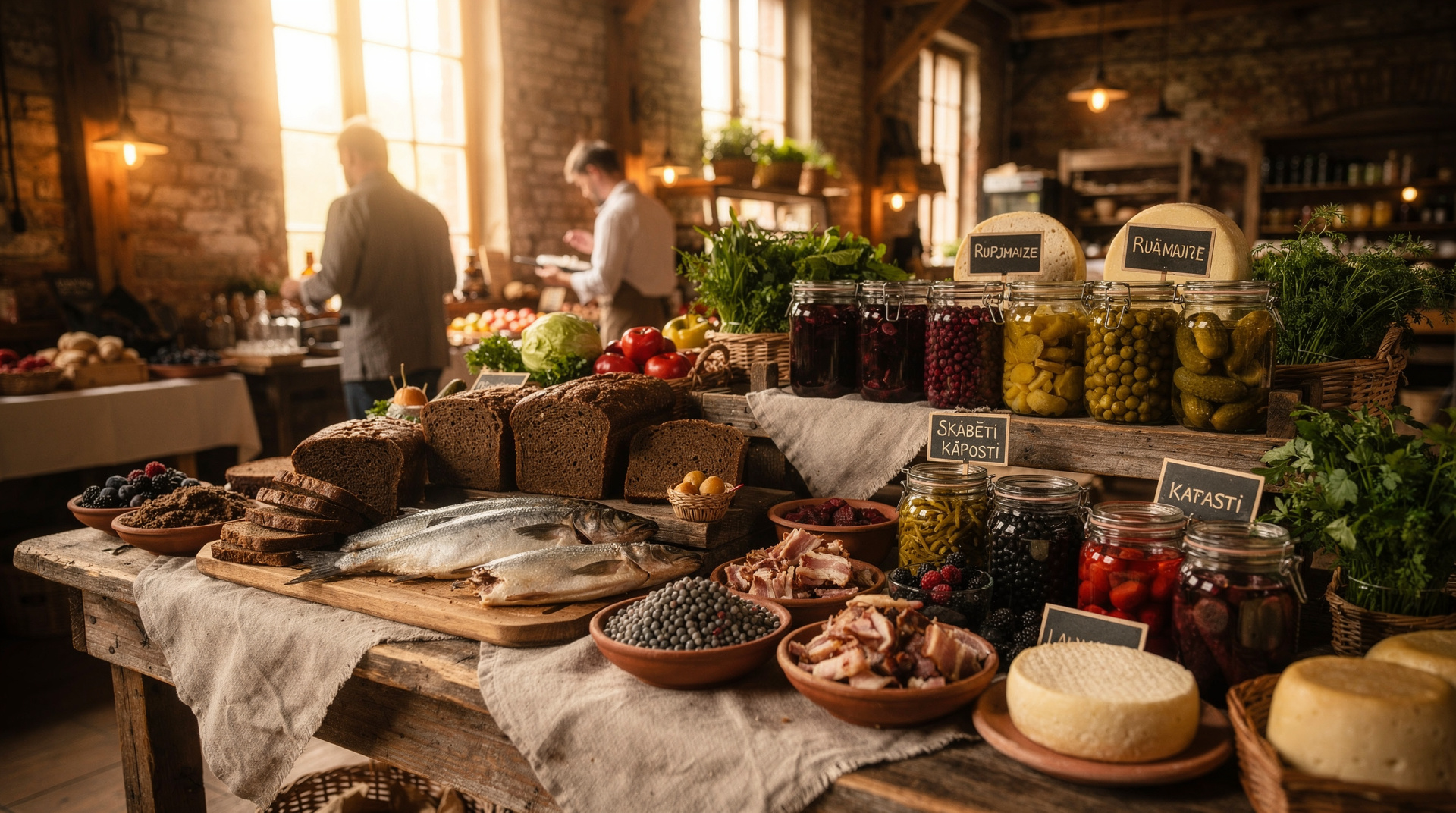
The dairy pavilion (Piena paviljons) — a revelation for visitors from Western European countries where supermarket homogenisation has flattened dairy culture. Latvian farmers’ cheeses (jaunpiens, Namsala sieriņi), cultured cream (skābs krējums), several varieties of kefir, fresh cottage cheese (biezpiens), and a range of rye breads that puts most European bakeries to shame. The dark Latvian rye bread — dense, slightly sour, made with a sourdough starter — is one of the most distinctive foods in the country and the dairy pavilion is an excellent place to buy it and to taste it with cheese and butter.
The vegetable pavilion (Dārzeņu un augļu paviljons) — seasonal produce from Latvian farms, supplemented by imports in winter. The quality of the local produce in summer is excellent: tomatoes, cucumbers, potatoes, berries, mushrooms, herbs. In autumn, the dried mushroom stalls are exceptional — Latvian forests produce extraordinary varieties, and the dried mushroom vendors at the Central Market sell them in bags that make serious souvenirs.
The flower pavilion — cut flowers, potted plants, and seasonal decorative items. Less immediately interesting for food visitors but worth a look for the extraordinary quality and range of Latvian-grown cut flowers in summer.
The outdoor market — surrounding the covered pavilions, the outdoor section runs along the Daugava embankment side of the market and includes additional vegetable and fruit vendors, honey sellers (Latvian honey is excellent and very varied), wild berry and mushroom gatherers selling their harvest directly, and in summer, vendors of fresh berries, radishes, and early vegetables. The outdoor section is less regulated and more chaotic than the covered pavilions, and it is often the best part.
Join a guided food tour of the Central Market (€43, 2 hours, small group)What to eat and buy
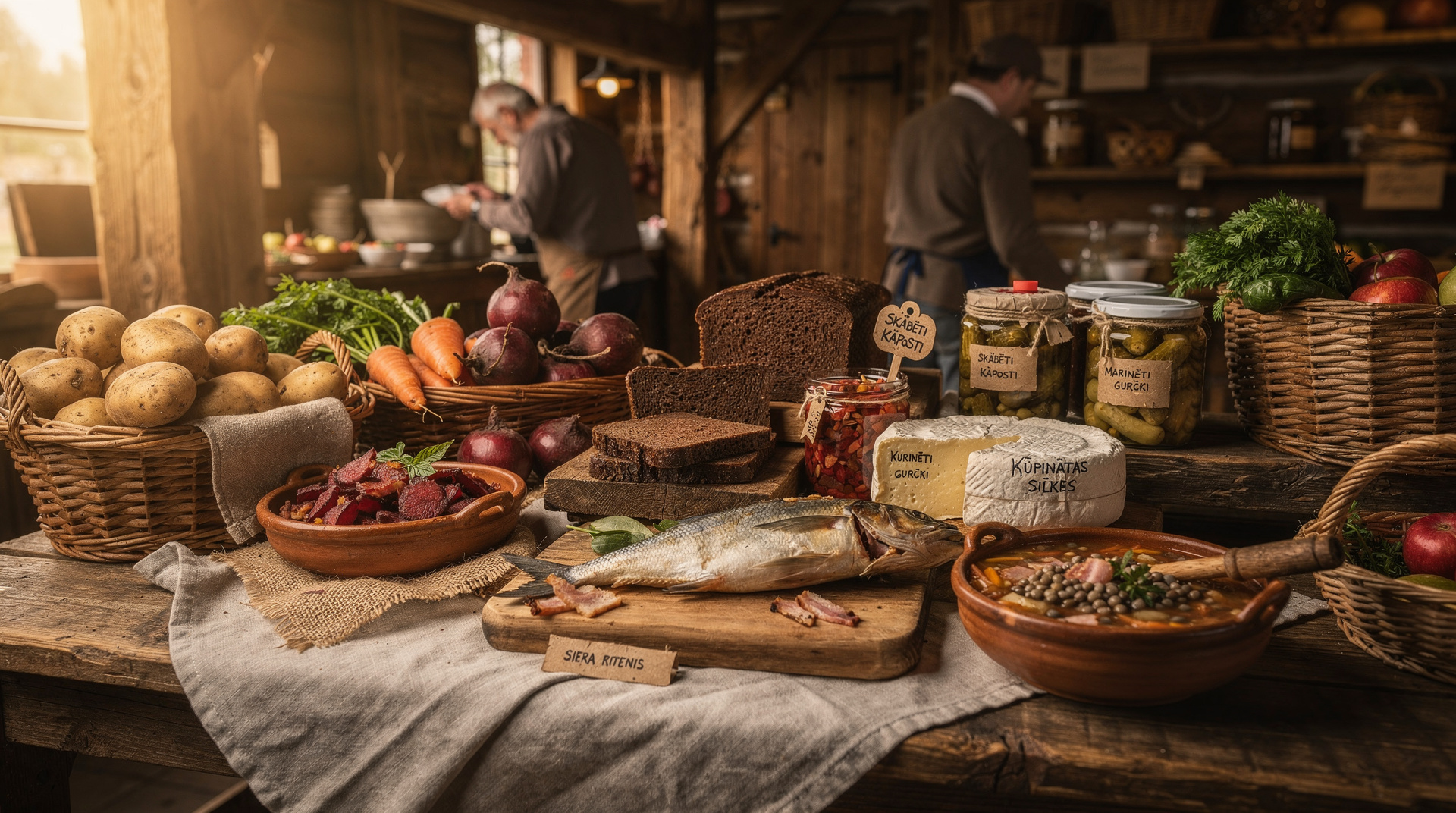
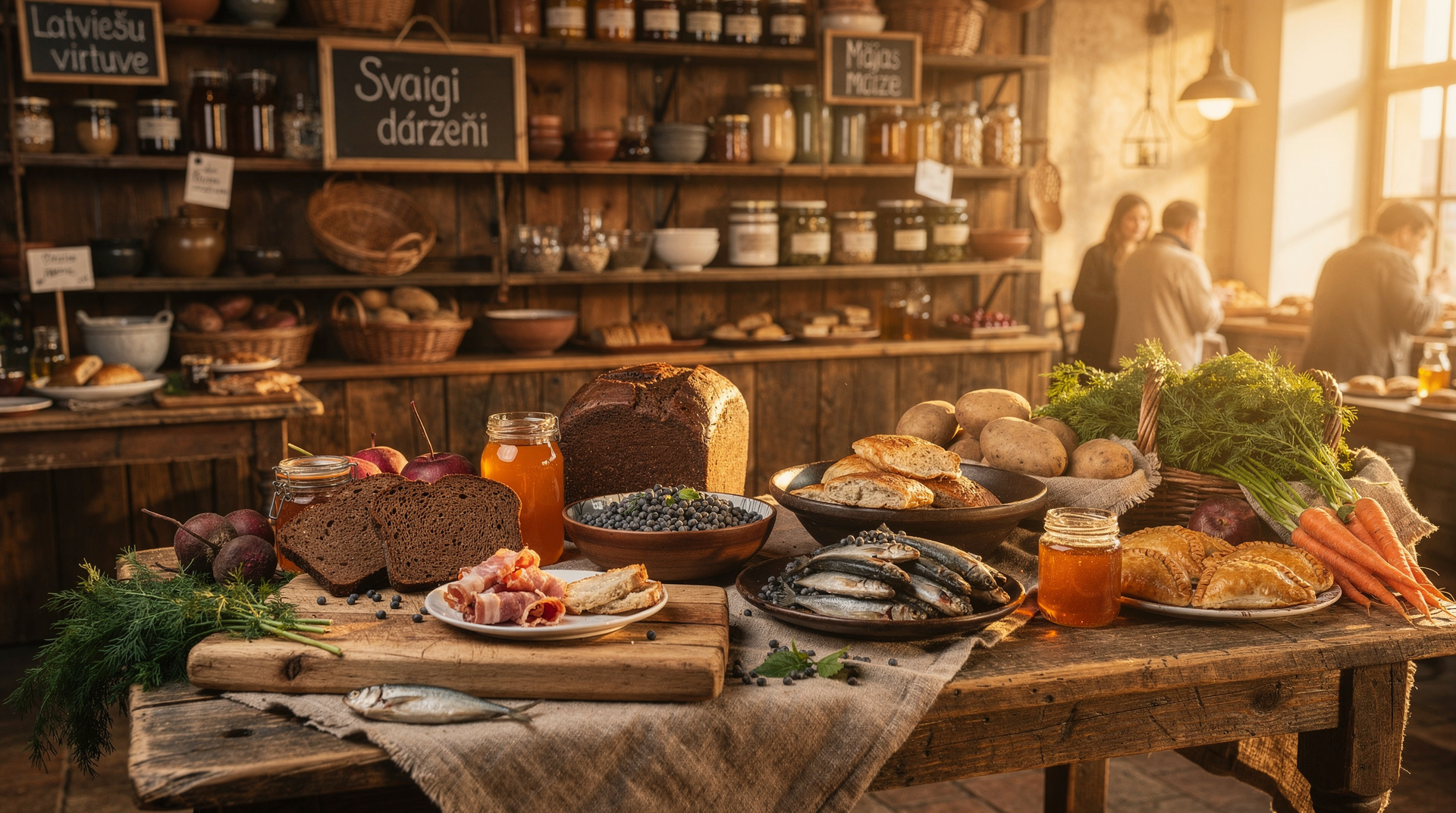
Rye bread. Latvian rye bread is one of the genuinely important foods in the country — not a sentimental souvenir but a product with real quality. The dairy pavilion has some of the best selections in Riga. Look for dark, dense loaves with a tight crumb and a slightly sour flavour; avoid the lighter “pseudo-rye” breads that are partly wheat. A good loaf costs €2–4 and keeps well for several days. See our guide to Latvian rye bread for context.
Smoked fish. The smoked eel in the fish pavilion is one of those foods that people who try it at the market remember for years. It is rich, fatty, and deeply smoky in a way that vacuum-packed versions cannot replicate. Budget €3–5 for a portion. The smoked herring is cheaper and also excellent.
Latvian cheeses. The dairy pavilion’s fresh farmers’ cheeses are worth trying — they are very different from aged Western cheeses, closer to quark or fresh curd, often flavoured with caraway seeds. A container costs €2–4 and is best eaten the same day.
Pickled vegetables. In the outer market area, look for vendors selling pickled cucumbers, sauerkraut, and the various fermented vegetable preparations that are central to Latvian winter food culture. These are good souvenirs if well-sealed, and excellent eating on the spot.
Honey. Latvian honey is varied and high-quality — buckwheat honey (a strong, dark variety), linden honey (pale and floral), and forest honey (complex, sometimes partly from wild plants). €5–12 per jar depending on size and variety.
Forest mushrooms (seasonal). In autumn (late August through October), the outdoor market has extraordinary dried mushroom and fresh mushroom vendors. Porcini (baraviku), chanterelles (gailenes), and birch boletes are typical. Dried mushrooms are an excellent souvenir — they are light, keep indefinitely, and are significantly better quality than anything available in Western supermarkets.
Food tours: are they worth it?
The short answer: for first-time visitors, yes. For visitors who have done extensive pre-research, potentially not necessary.
The Central Market is large, slightly chaotic, and — if you don’t speak Latvian or Russian — potentially difficult to navigate in terms of knowing which vendors are worth visiting and which are average. A guided food tour handles translation, navigates to the best vendors, provides historical context about the hangars, and includes tastings.
The best option is the small-group Central Market food tour (€43, 2 hours). It is consistently rated 4.7/5 across 690 reviews — a high review count that indicates reliable departure and consistent quality. The tour includes tastings, so you are not just paying for a walk with commentary; you are also paying for food.
The alternative — the Flavours of Riga tour (€48, 3 hours) — covers the Central Market as part of a broader food and history walk through Old Town and is better for visitors who want both food and cultural context.
Try the Flavours of Riga food, history and hidden gems tour (€48, 3 hours)Honest tips for visiting the Central Market
Cash. Bring it. Many vendors are cash-only or cash-preferred, particularly in the outdoor sections. Small denominations (€5, €10) are useful.
Come before 11:00. The market is most alive in the early morning. By noon the crowds increase and some vendors start running low on the best produce. By 14:00 on a weekday, the energy drops noticeably.
Don’t skip the outdoor section. The covered pavilions are the obvious draw, but the outdoor market — particularly in summer and autumn — has the most interesting small vendors: direct sellers of forest berries, mushroom gatherers, honey producers from individual farms. These are not in the covered halls.
The café inside the market. There is a working-class canteen inside the main market building (near the dairy pavilion) that serves hot food from a steam table — soups, meat dishes, potatoes — at prices of €3–6 a plate. It is genuinely cheap, genuinely local, and entirely lacking in atmosphere for Instagram purposes. It is also one of the most authentic cheap eating experiences in Riga.
Toilets. Available inside the market for a small fee (typically €0.20–0.30). Worth knowing.
Frequently asked questions about Riga Central Market
What can I buy at the Riga Central Market?
The market is divided into specialist pavilions: meat, fish, dairy and vegetables as the main covered halls, plus a large outdoor section with seasonal produce, honey, pickles, dried mushrooms, and forest berries. The dairy pavilion is particularly good for Latvian cheeses, cultured dairy, and rye bread. The fish pavilion has smoked fish typical of Baltic markets.
Is cash or card accepted at the Central Market?
Most vendors in the Central Market are cash-preferred or cash-only. Bring euros in small denominations. ATMs are available near the market entrances and at the adjacent Central Station.
Is the Central Market food tour worth it?
For first-time visitors who don’t know what they’re looking at, yes. A guided food tour (€40–48) covers the history of the hangars, takes you to the vendors worth visiting, handles translation, and includes tastings.
How far is the Central Market from Old Town?
About 1 km south-east of Old Town, a 12–15 minute walk along Aspazijas bulvāris. Alternatively, take Bolt (€3–4, 4 minutes).
What are the Central Market’s opening hours?
Generally Monday–Sunday 07:00–18:00, with some outdoor vendors starting earlier. Tuesday to Saturday is the most fully staffed.
For more on Latvian food, see our guide to the best Latvian foods to try in Riga and our guide to Latvian rye bread, pelmeni and pīrāgi. For cooking classes, see our overview of Latvian cooking classes.
The Zeppelin hangars: architectural history
The Central Market’s most distinctive feature is its five pavilions — enormous steel-framed structures originally built as Zeppelin hangars for the German military during World War I. Understanding the buildings’ origin changes how you experience them.
The hangars were constructed between 1915 and 1917 at the Vaiņode military airfield in southern Latvia, intended to house the large rigid-frame airships (Zeppelins) that Germany deployed for reconnaissance and bombing operations. When German forces withdrew from Latvia after World War I, the hangars were left behind. In the early years of Latvian independence, the Riga city authorities identified them as a potential solution to the growing city’s need for a modern, covered market.
Dismantled at Vaiņode and reassembled in central Riga between 1924 and 1930, the five hangars were repurposed as market pavilions — fish, meat, dairy, vegetables, and general goods — in an arrangement that was architecturally ingenious and practically effective. Each hangar has a distinctive silhouette: the rounded barrel vault of the large structures, with corrugated metal cladding, sits immediately behind the Central Station, visible from across the canal park.
In 1997, UNESCO included Riga’s historic centre — including the Central Market — on the World Heritage List. The market was specifically cited as “one of the biggest and most outstanding examples of market architecture in Europe.” This is the correct assessment. The Central Market is not just a market; it is a major work of adaptive reuse that turns military infrastructure into one of the largest covered market spaces in Europe.
Standing inside the fish pavilion — the largest of the five, 86 metres long and 46 metres wide — and looking up at the curved steel vault is one of the genuinely impressive architectural experiences in Riga. The scale is not obvious from outside; inside, the hangar space is striking.
The market in Riga’s food culture: what it means
The Central Market is not primarily a tourist attraction. It is a working market that has been a central institution of Riga’s food culture for nearly 100 years. Its role in the city goes beyond commerce.
As a social space. Riga residents of all backgrounds — Latvian, Russian-speaking, and recent arrivals — shop at the Central Market. It is one of the few genuinely mixed social spaces in a city where the different linguistic communities often occupy separate commercial and social spheres. The market canteen — the steam-table cafeteria inside the main building — serves a democratic mix of shoppers and workers at prices accessible to everyone.
As a preserving institution. Many of the vendors at the Central Market are multi-generational — families who have occupied the same stalls for decades, selling products from the same farms and fishing operations that supplied their parents and grandparents. The smoked fish vendor who has occupied the same position in the fish pavilion for 30 years maintains a continuity of craft that supermarkets cannot replicate.
As a seasonal indicator. The outdoor section of the Central Market, where small agricultural vendors set up their stalls, is the most accurate seasonal indicator in Riga. When the first strawberries arrive in June, when the mushroom season begins in August, when the autumn root vegetables come in October — the outdoor market records these transitions more reliably than any calendar. For visitors interested in Latvian food culture as a seasonal practice, the outdoor section in any season is worth spending time in.
What the food tours add beyond self-guided visits
The Central Market is large, the products are often unlabelled in English, and the vendors range from excellent to mediocre. A food guide provides three things that independent navigation cannot easily replicate.
Vendor selection. The guide knows which vendors have consistently good smoked fish, which dairy stall has the best cottage cheese, which rye bread is worth buying. This knowledge takes years to develop; the guide transfers it to you in 2 hours.
Translation and context. Many products in the market have names that are meaningful in Latvian but opaque in translation. The guide explains what kultūrpiens (cultured milk, similar to kefir) is, what skābeņu zupa (sorrel soup) tastes like, why there are 15 varieties of rye bread rather than one. The tasting component turns explanation into experience.
The Zeppelin hangar history. The architectural context — why these structures look the way they do, where they came from, what they were before they were a market — is not posted on any sign in the market. The guide provides it, and it changes how you look at the buildings you are standing inside.
The food tour is not necessary for visitors who have done the research before arriving — reading this guide and the best Latvian foods guide before visiting provides a substantial portion of the guide’s context. But the vendor selection and tasting access are more difficult to replicate independently.
Practical tips for getting the most from a solo market visit
Go early. The Central Market is most fully staffed between 08:00 and 11:00. The fish pavilion in particular has the widest variety and the freshest stock in the morning. The outdoor section fills up from 08:00 on weekdays and from 07:30 on weekends.
Bring cash. Most vendors are cash-only or cash-preferred. €20–30 is sufficient for a morning of tasting and purchasing.
Start in the dairy pavilion. The dairy pavilion has the best variety of Latvian cultured dairy products — fresh cottage cheese, various forms of sour cream, butter, and cultured milks. Tasting your way through the dairy pavilion sets the palate for the rest of the market and introduces the flavour profile of Latvian food (fermented, sour, clean) efficiently.
The canteen. The Central Market canteen in the main pavilion building serves hot food from approximately 09:00 — soups, meat dishes, potato preparations — at €3–5 a plate. It is the most honest and most economical lunch in central Riga, and the atmosphere (long tables, plastic trays, Soviet-era interior) is part of the experience.
Frequently asked questions
What can I buy at the Riga Central Market?
The market is divided into specialist pavilions: meat, fish, dairy and vegetables as the main covered halls, plus a large outdoor section with seasonal produce, honey, pickles, dried mushrooms, and forest berries. The dairy pavilion is particularly good for Latvian cheeses, cultured dairy, and rye bread. The fish pavilion has smoked fish typical of Baltic markets.Is cash or card accepted at the Central Market?
Most vendors in the Central Market are cash-preferred or cash-only. Bring euros in small denominations. ATMs are available near the market entrances and at the adjacent Central Station. Card readers are increasingly common but cannot be relied upon universally.Is the Central Market food tour worth it?
For first-time visitors who don't know what they're looking at, yes. A guided food tour (€40–48) covers the history of the hangars, takes you to the vendors worth visiting, handles translation, and includes tastings. Self-guided visitors who have done some research can do the market independently for the cost of what they buy.How far is the Central Market from Old Town?
About 1 km south-east of Old Town, a 12–15 minute walk along Aspazijas bulvāris and past the National Theatre. Alternatively, take Bolt (€3–4, 4 minutes). The market is directly adjacent to the Central Railway Station and bus station.What are the Central Market's opening hours?
Generally Monday–Sunday 07:00–18:00, with some outdoor vendors starting earlier. The indoor pavilions run most consistently Tuesday to Saturday. Monday is the quietest day with some vendors absent. Hours can vary seasonally — the market is most fully staffed in summer.
Top experiences
Bookable activities with verified prices and instant confirmation on GetYourGuide.
Riga: Central Market traditional food tour in a small group
- Tastings included
- Small group
Riga: Central Market Latvian food tour
- Tastings included
Flavours of Riga: food, history & hidden gems tour
- Tastings included
- Best seller
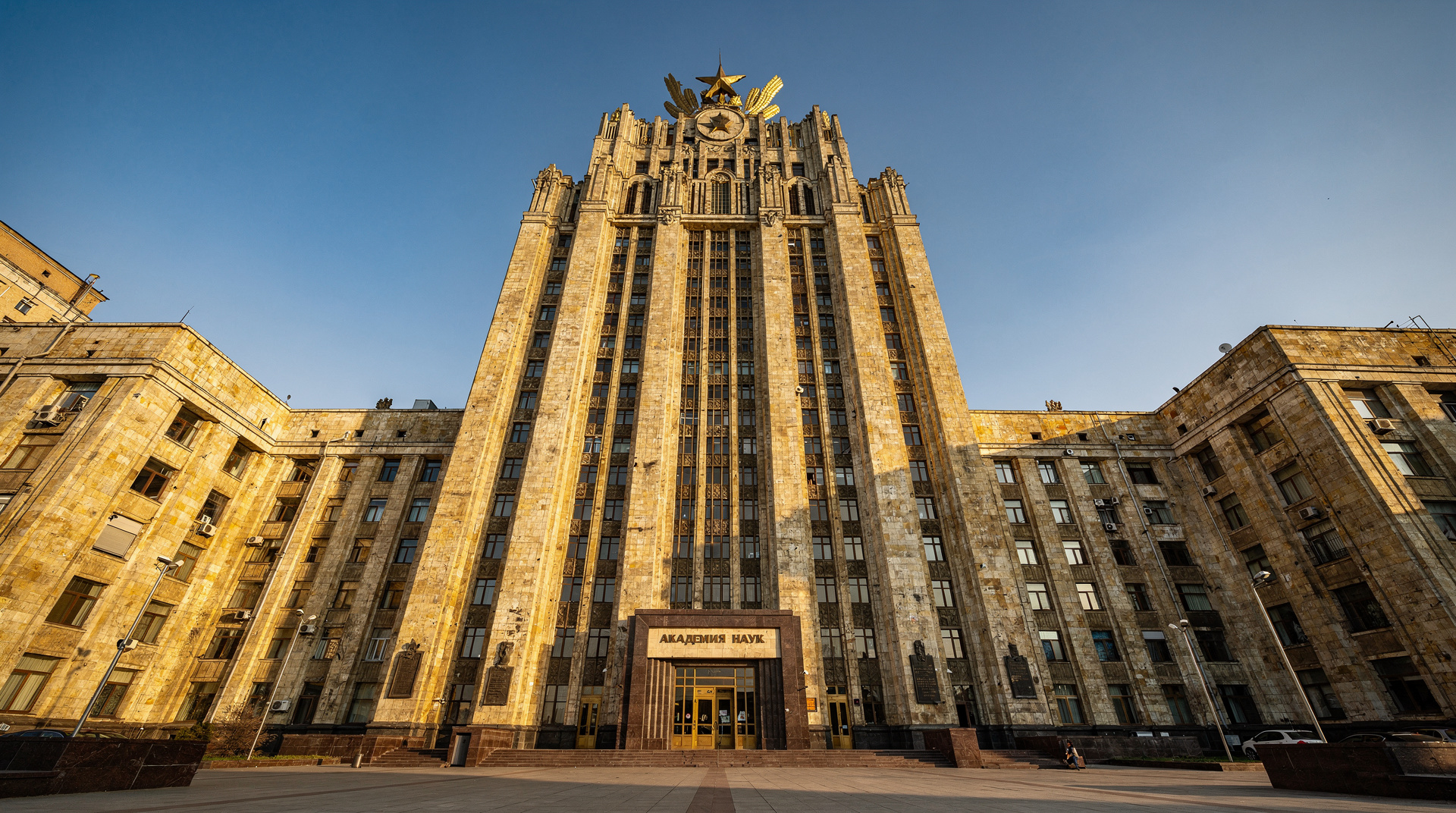
Riga: Central Market tasting tour with Academy of Sciences views
- Tastings included
- Viewpoint